

Britain faces growing political and social strain as austerity measures, expanded security powers, and foreign policy challenges collide. This summer’s mass protest in Parliament Square, where over 500 people were arrested for supporting the proscribed group Palestine Action, exposed deep divisions in the country. The state’s authority is tested by a public increasingly distrustful of government institutions and policing methods.
With protests met by unprecedented mass arrests and harsh legal repercussions under the 2000 Terrorism Act, Britain’s democratic freedoms appear under pressure. The diverse group of demonstrators including many older, traditionally conservative citizens signals broad dissatisfaction across the political spectrum. As the government tightens control, activists vow continued defiance, raising urgent questions about justice, free speech, and the future of protest in the UK.
Mass Arrests at Parliament Square: A Record-Breaking Police Operation
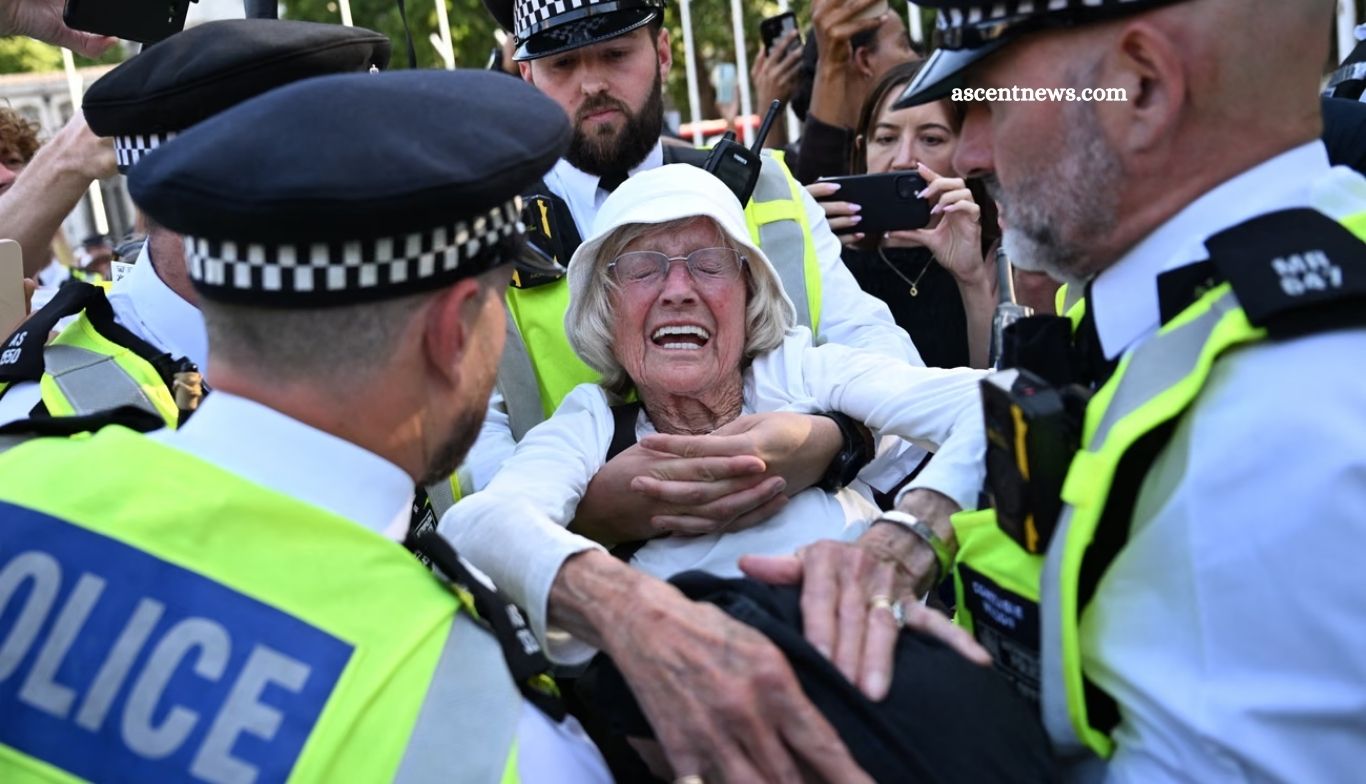
This tension was visible last Saturday during one of London’s largest mass arrests in history. At Parliament Square, police detained 521 people for holding simple signs with a seven-word message supporting Palestine Action a group recently proscribed under anti-terror laws. The officers’ faces flushed with exertion in the hot sun as they managed the crowd, lifting protesters one by one while avoiding overt displays of force on camera.
The arrested protesters were carried through jeering crowds shouting “genocide police!”, “shame on you!”, and “fascist scum!” before being loaded into police vans. Some officers came from Wales to support the operation a level of inter-nation cooperation unimagined when Welsh devolution was established 26 years ago.
Read More: Britain’s immigration fearmongering: How Starmer and team exploit it for cheap votes
Overwhelmed Systems and Legal Consequences
Due to the unprecedented number of arrests, London’s police custody system neared capacity. Authorities resorted to “makeshift outdoor processing centres,” reminiscent of responses during major breakdowns in public order. Some released on bail reportedly returned to protest, highlighting challenges in enforcing bans on groups like Palestine Action.
The Metropolitan Police admitted it was “entirely unrealistic” to identify and prevent those returning to the protests, raising questions about the practical effectiveness of these measures. If charged, those arrested face an overburdened criminal justice system and crowded prisons, while organizers promise continued acts of civil disobedience aimed at undermining the government’s proscription efforts.
The Terrorism Act and Its Controversial Reach
The proscription of Palestine Action relies on a 2000 amendment to the Terrorism Act, a legacy of Tony Blair’s government. Under this law, anyone displaying materials supporting the group could be jailed for up to six months; those inviting support risk up to 14 years in prison. This legal framework has sparked debate over its fairness and impact on free speech.
One protester, a woman wearing a panama hat and sitting calmly on a camping stool, encapsulated the complex political atmosphere: “I don’t like the Guardian, I read the Telegraph.” This signals a wide-ranging discontent that transcends traditional media and political divides.
Rising Authoritarianism Amidst Austerity
Britain has seen a parallel rise in austerity and authoritarianism. Public spending cuts following the relatively generous Blair years coincide with growing radical activism around climate change and Palestine. Yet Labour’s leadership appears committed to law-and-order solutions, possibly due to the backgrounds of key figures like Keir Starmer, former director of public prosecutions, and Home Secretary Yvette Cooper, a national security expert.
While the government pursues tougher security measures, protesters at Parliament Square voiced fierce opposition to what they see as a failing political and policing system, incapable of addressing today’s urgent crises.
Protesters’ Silent Defiance: A Powerful Statement
Throughout the day, many protesters sat quietly on the ground, their backs to Parliament, carefully displaying their placards. This positioning was a deliberate act of defiance, symbolizing rejection of the House of Commons, where the proscription was overwhelmingly approved—only 26 MPs voted against it.
Parliament often prides itself on defending liberty, yet in moments of political panic, its commitment to liberal values often fades. Meanwhile, protesters highlight the shrinking space for lawful dissent in Britain.
A Diverse and Unlikely Coalition of Protesters
Surprisingly, nearly half of those arrested were aged 60 or older—a group typically associated with conservative politics. Many had backgrounds in middle-class public service, lending a different face to the protest movement. Their quiet camaraderie during lulls in police action suggested a scene more akin to a cultural festival than a political uprising.
This diversity echoes past moments of broad opposition to government policies, such as during the early 2000s under Blair’s leadership. However, questions remain about the consistency of rightwing critics, especially when Tory governments engage in similar military or civil liberty restrictions.
Political Fallout and the Limits of Law-and-Order Approaches
The Palestine Action controversy poses significant political risks for Labour. After the Iraq war and tough anti-terror legislation, Blair’s party suffered substantial voter losses, despite retaining power. Today, with Labour less popular, Keir Starmer must tread carefully to avoid alienating anti-war and civil liberties supporters, even if some within his party favor stricter security measures.
Beyond electoral politics, the issue raises fundamental concerns about democracy, justice, and human rights in Britain.
The Shrinking Space for Protest and the Global Context
As police tightened their cordon, some protesters expressed doubts about continuing, fearing the consequences. One elderly woman confessed her mixed feelings, highlighting how legal protections for peaceful protest in Britain are eroding.
Meanwhile, the crisis in Gaza—invoked by the protests—remains a stark reminder of a place where no safe space exists at all. The contrast between Britain’s shrinking freedoms and Gaza’s brutal conditions sharpens the moral urgency behind the protests.
Frequently Asked Questions
What prompted the mass arrests at Parliament Square during the Palestine Action protest?
The arrests followed a large demonstration where over 500 people displayed signs supporting Palestine Action, a group recently banned under anti-terror laws. Police acted to enforce the proscription, resulting in one of London’s largest mass arrests.
How has the UK government’s approach to security changed in recent years?
The government has expanded security powers and policing tactics, often justified by anti-terrorism concerns. This includes tougher laws, increased surveillance, and more aggressive enforcement against groups deemed a threat, reflecting a shift toward authoritarian measures.
What is the significance of the Terrorism Act amendment related to Palestine Action?
The amendment criminalizes displaying materials or inviting support for proscribed groups like Palestine Action. It allows for jail sentences of up to six months for public displays and up to 14 years for encouraging support, raising concerns about free speech limitations.
Why are so many older protesters involved in the Palestine Action demonstrations?
Nearly half of those arrested were aged 60 or older, many with middle-class backgrounds. This reflects broad political dissatisfaction, showing that opposition to government policies on Palestine crosses typical demographic and political lines.
How are the police managing such large-scale protests and arrests in London?
The police deployed officers from across the UK, including Wales, and used “makeshift outdoor processing centres” to handle the high number of arrests. Despite this, managing crowd control and repeat protesters remains challenging.
What are the potential legal consequences for those arrested supporting Palestine Action?
Those arrested may face charges under the Terrorism Act, leading to possible prison sentences. If convicted, they enter an overburdened criminal justice system and face the prospect of incarceration in crowded prisons.
How does austerity relate to rising authoritarianism in Britain?
Public spending cuts have coincided with the government’s increasing focus on security and control. This combination has strained resources and heightened social tensions, contributing to the rise of more authoritarian policies amid austerity.
Conclusion
The mass arrests at Parliament Square and the government’s strict crackdown on Palestine Action reveal a Britain at a crossroads. Faced with austerity, rising authoritarianism, and widespread political disillusionment, the state struggles to balance security with democratic freedoms. The diverse coalition of protesters signals deep public frustration across generations and political lines.
As activists vow continued resistance and the legal system becomes increasingly burdened, questions about justice, free speech, and the future of protest in the UK demand urgent attention. How Britain navigates these challenges will shape its political landscape and civil rights for years to come.